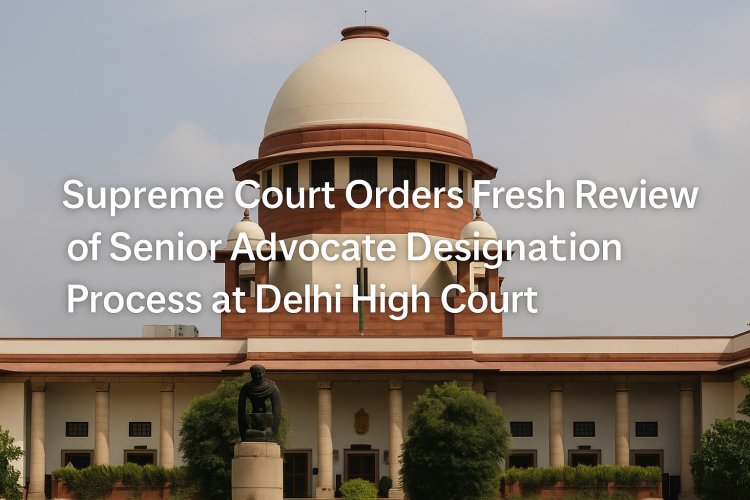
Supreme Court Orders Fresh Review of Senior Advocate Designation Process at Delhi High Court
The Supreme Court mandates a comprehensive reassessment of the senior advocate designation process at the Delhi High Court, addressing concerns over interview efficacy.
Need an Advocate in Delhi?
Get connected for legal assistance regarding your matter.
Speak with an Advocate • Multiple Languages Supported
Background of the Issue
The designation of senior advocates is a prestigious honor in the Indian legal system, conferred upon lawyers who demonstrate exceptional ability and integrity. However, the existing process, which includes a point-based assessment and a brief interview, has been criticized for its potential shortcomings in thoroughly evaluating a candidate's suitability.
Supreme Court's Observations
A bench comprising Justices Abhay S. Oka and Ujjal Bhuyan expressed reservations about the current methodology, questioning whether a short interview could adequately assess an advocate's qualifications and ethical standing. The Court highlighted the lack of mechanisms to penalize candidates with known integrity issues, as the current system does not allow for point deductions based on ethical concerns .
Role of the Permanent Committee
The Permanent Committee, responsible for evaluating candidates, currently assigns points based on various criteria, including years of practice, judgments, publications, and interview performance. However, the Supreme Court clarified that the Committee's role is limited to assigning points and does not extend to recommending candidates for designation .
Concerns Over the Interview Process
The Court raised doubts about the efficacy of the interview component, which accounts for 25 out of 100 points in the assessment. It questioned whether such a brief interaction could truly capture an advocate's capabilities and ethical standards. The Court suggested that relying heavily on interviews might not provide a holistic view of a candidate's qualifications .
Need for Ethical Considerations
A significant concern highlighted by the Court is the absence of a structured approach to evaluate a candidate's integrity. The current system lacks provisions to deduct points for ethical lapses or ongoing disciplinary proceedings, potentially allowing individuals with questionable ethics to attain senior designation .
Call for Comprehensive Review
In light of these issues, the Supreme Court has referred the matter to the Chief Justice of India to consider forming a larger bench for an in-depth examination. The Court emphasized the need for a system that ensures only deserving advocates, who meet both professional and ethical standards, are designated as senior advocates .
Implications for the Legal Community
This directive from the Supreme Court is expected to have far-reaching implications for the legal fraternity. It underscores the importance of integrity and comprehensive evaluation in the designation process, potentially leading to reforms that prioritize ethical considerations alongside professional achievements.
Conclusion
The Supreme Court's call for a fresh assessment of the senior advocate designation process at the Delhi High Court marks a significant step towards ensuring fairness and integrity in the legal profession. By addressing concerns over the interview process and ethical evaluations, the Court aims to uphold the sanctity of the senior advocate title and reinforce public trust in the judiciary.
FAQs
Q1: What prompted the Supreme Court to order a reassessment of the senior advocate designation process?
A1: Concerns over the effectiveness of brief interviews and the lack of mechanisms to evaluate candidates' ethical standards led the Supreme Court to mandate a comprehensive review.
Q2: What is the role of the Permanent Committee in the designation process?
A2: The Permanent Committee is responsible for assigning points to candidates based on specific criteria but does not have the authority to recommend individuals for designation.
Q3: How does the current interview process impact the assessment of candidates?
A3: The interview accounts for 25% of the total assessment points. However, the Supreme Court questioned whether such brief interactions could adequately evaluate a candidate's suitability and integrity.
Q4: Why is there a need to consider ethical standards in the designation process?
A4: The absence of a structured approach to assess candidates' ethics could allow individuals with questionable integrity to attain senior designation, undermining the honor's credibility.
Q5: What are the potential outcomes of the Supreme Court's directive?
A5: The directive may lead to reforms in the designation process, incorporating more comprehensive evaluations that balance professional achievements with ethical considerations.