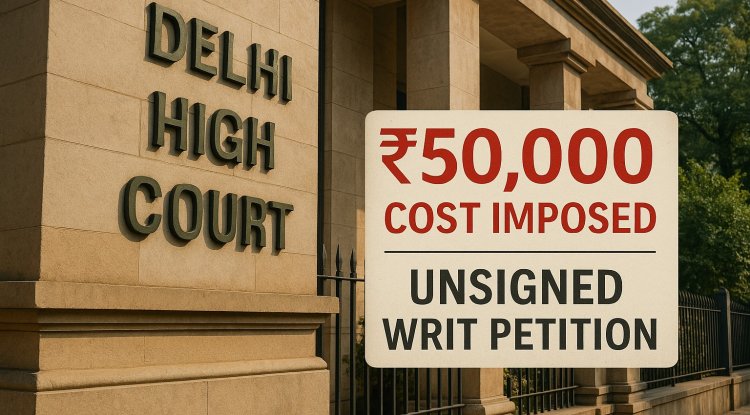
Delhi High Court Imposes ₹50,000 Cost Over Unsigned Writ Petition
Delhi High Court penalises petitioners ₹50,000 for filing an unsigned writ petition lacking direct interest. Court warns against frivolous petitions,
Need an Advocate in Delhi?
Get connected for legal assistance regarding your matter.
Speak with an Advocate • Multiple Languages Supported
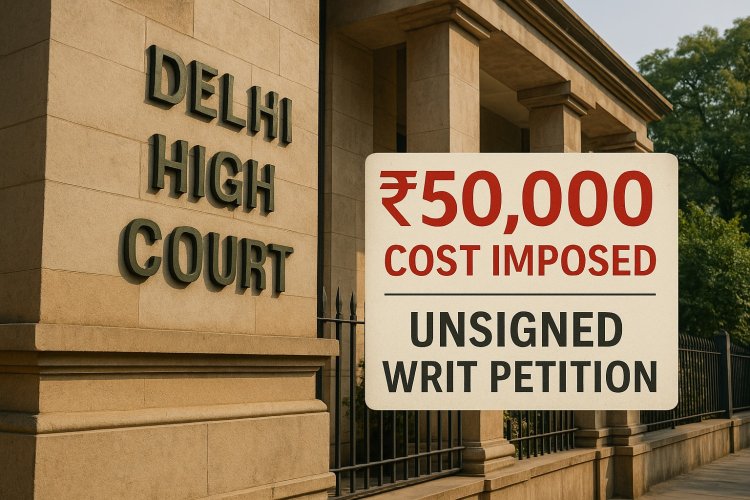
The Delhi High Court recently imposed a cost of ₹50,000 on a petitioner for filing a writ petition that lacked the petitioner’s signature and had no legitimate basis in law. The petition was dismissed as frivolous and a misuse of the court's jurisdiction under Article 226 of the Constitution.
Case Background
The petitioner challenged alleged illegal construction near a gurdwara in Mehrauli. However, the petitioner resided more than 10 kilometers from the site and had no direct connection to the property or issue at hand. The writ petition also failed to include the petitioner's signature, a basic procedural requirement.
Justice Mini Pushkarna, presiding over the case, noted that the petition lacked legal merit and was an abuse of the court's writ jurisdiction. The bench emphasized that Article 226 cannot be invoked for casual grievances or mere inconveniences.
Court’s Observations
The High Court highlighted the following:
-
The petitioner did not demonstrate any direct legal or fundamental right being violated.
-
The petitioner's interest in the matter was too remote and did not justify the invocation of constitutional remedies.
-
The absence of the petitioner’s signature on the petition raised serious procedural concerns.
-
Filing petitions without standing or legal basis clogs the judicial system and wastes valuable court time.
Imposition of Costs
As a result, the Court dismissed the petition and imposed a cost of ₹50,000 on the petitioner. The amount was directed to be deposited with the Delhi High Court Advocates Welfare Trust within four weeks. The Court made it clear that such penalties are necessary to deter misuse of judicial processes.
Broader Context and Judicial Precedents
This case is part of a broader trend where Indian courts are taking a firm stance against frivolous litigation:
-
In earlier judgments, the Delhi High Court imposed similar penalties ranging from ₹10,000 to ₹3,00,000 for abuse of legal process.
-
The courts have repeatedly warned litigants against using writ jurisdiction for publicity or personal vendettas without legal standing.
Such steps reflect the judiciary’s commitment to preserving the integrity and seriousness of constitutional remedies.
Frequently Asked Questions (FAQs)
Q1: Why is the petitioner’s signature so important?
A: The signature authenticates the petition and confirms that the petitioner has read and approved its contents. Without it, the petition lacks legal validity.
Q2: What is meant by 'direct interest' in a writ petition?
A: A petitioner must show a personal or legal interest in the matter. Courts generally reject petitions filed by individuals with no direct or affected involvement.
Q3: Is ₹50,000 a standard penalty in such cases?
A: The amount of costs varies based on the court’s discretion. However, ₹50,000 is not uncommon in cases involving procedural violations or frivolous claims.
Q4: Where is the penalty amount deposited?
A: In this case, the fine was directed to be paid to the Delhi High Court Advocates Welfare Trust.
Q5: Can the cost order be appealed?
A: Yes, the petitioner may file an appeal before a Division Bench of the High Court or move the Supreme Court. However, they must provide strong legal grounds to challenge the dismissal and cost order.
Conclusion
This case underscores the importance of procedural correctness and genuine legal interest in matters brought before the court. The Delhi High Court’s decision sends a strong message: writ petitions must be filed responsibly, with full compliance to rules and legitimate cause. Misusing the court's jurisdiction not only leads to dismissal but also financial penalties that serve as a caution to others.