Delhi High Court Denies Bail to Lawyer in Road Rage Case
Delhi HC denies anticipatory bail to lawyer in road rage case, emphasizing equality before law and the serious ramifications of public violence.
Need an Advocate in Delhi?
Get connected for legal assistance regarding your matter.
Speak with an Advocate • Multiple Languages Supported
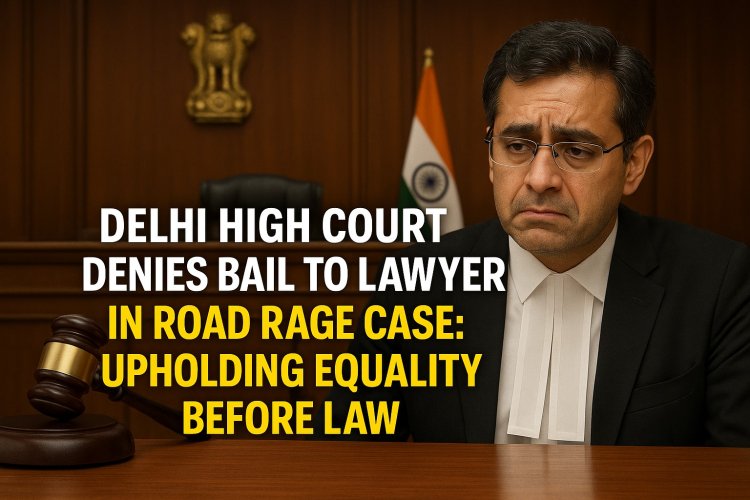
In a significant judgment reinforcing the principle of equality before the law, the Delhi High Court has denied anticipatory bail to Advocate Raj Kumar Chaudhary, accused in a violent road rage incident. The court emphasized that granting bail in such cases could send a wrong message to society, suggesting that individuals in esteemed professions might receive preferential treatment.
The Incident
The case pertains to an alleged assault in February 2025, where Advocate Raj Kumar Chaudhary and his brother, Gajraj—president of the Bajrang Vahini Dal—reportedly attacked a software engineer commuting on his two-wheeler towards Deoli Road. The victim sustained multiple injuries, including a head wound that the court noted could have been life-threatening.
Court's Observations
Justice Girish Kathpalia, presiding over the case, observed that "granting anticipatory bail in the broad daylight violence of the present nature at a public place would send wrong signals across the society that the aggressor took law in hands and walked free just because he happens to be an advocate." He further stated, "All are equal in the eyes of law and none can be treated as more equal.
The court highlighted that road rage incidents have wide-ranging ramifications, not just causing physical injuries but also psychological trauma to the victims. Justice Kathpalia emphasized that such acts, especially when committed by individuals expected to uphold the law, could undermine public confidence in the legal system.
Custodial Interrogation and Investigation
The investigating officer expressed the need for custodial interrogation to recover the assault weapon and conduct further investigation. Taking this into account, the court concluded that the case did not merit the grant of anticipatory bail.
Implications for the Legal Profession
This judgment serves as a stern reminder that members of the legal profession are not above the law. Justice Kathpalia noted that granting bail in such circumstances would "malign the noble profession of advocacy." The court's decision underscores the expectation that legal professionals must adhere to the highest standards of conduct, both in and out of the courtroom.
Conclusion
The Delhi High Court's refusal to grant anticipatory bail in this road rage case reinforces the principle that the law applies equally to all, regardless of profession or social standing. It sends a clear message that violent behavior, especially by those entrusted with upholding the law, will not be tolerated and will be met with strict legal consequences.
Frequently Asked Questions (FAQs)
Q1: Who is Advocate Raj Kumar Chaudhary?
A1: Advocate Raj Kumar Chaudhary is a lawyer accused in a road rage incident involving the assault of a software engineer in Delhi.
Q2: What was the court's rationale for denying bail?
A2: The court emphasized that granting bail in cases of public violence could send a wrong message, suggesting preferential treatment for certain professions, and could undermine public confidence in the legal system.
Q3: What injuries did the victim sustain?
A3: The victim suffered multiple injuries, including a head wound that the court noted could have been life-threatening.
Q4: What does this judgment imply for legal professionals?
A4: The judgment underscores that legal professionals are expected to uphold the law and maintain high ethical standards. Engaging in unlawful activities can lead to severe legal consequences, regardless of one's professional status.
Q5: What are the broader implications of this case?
A5: The case highlights the judiciary's commitment to upholding the rule of law and ensuring that all individuals, regardless of profession or social standing, are held accountable for their actions.